Pages

Showing posts with label Physic. Show all posts

Wednesday, May 12, 2021

What is heat death of universe

Heat death:

condition when there is no ( physical / biological / chemical )changes occur is known as heat death of universe.

 'There are some things we need to know to understand about the heat death of universe.

Like what  is entropy, processes(reversible or irreversible)'


click here to understand about entropy...


[  reversible process is processor which can reverse to its initial state. it is ideal state, whereas ir-reversible process is process which cannot reverse to its initial state]

[Entropy is the measure of disorder of a system]


Suppose there is a refrigerator and a surrounding.


If you consider the refrigerator, the temperature inside the refrigerator is less  than the surrounding,  and it decreases with time.
 But how is it possible?  this is violation of 2 law of thermodynamics.

[ The Second Law of Thermodynamicsstates that the state of entropy of the entire universe, as an isolated system, will always increase over time. The second law also states that the changes in the entropy in the universe can never be negative]


So here let me tell you that work is being done to reduce the temperature of refrigerator.

The refrigerator coil is plugged in and takes electric energy. Stand alone we can't consider refrigerator as isolated system.

[An isolated system is a thermodynamicsystem that cannot exchange either energy or matter outside the boundaries of the system ]

It is worked from outside.Therefore, one who is working will also have to be consider  in this thermodynamic system.i.e[refrigerator + surrounding]

 the refrigerator continuously releases the heat energy from behind which maintain low temperature of refrigerator.

And if we look at the surroundings, we will find that temperature of surrounding is increasing.

#So if we look at the entire system ie (universe) then the entropy of the whole system is increasing.#.


There is a lot of concentrated heat energy in the sun, it is continuously releasing the energy,

and the rise of entropy is the basic feature of the Universe... Entropy of universe is continuously increasing.
This will go on and there will come a time when the energy density in universe will be equal.i.e
(Temperature of universe will become same at each  and every point).


This is known as heat death of universe, at this stage there will be no transfer of energy/heat.
 No mechanism will work :physical engine(machine), living engine(living beings).

This is known as death of universe.


Entropy of universe = maximum at that point


Entropy and 2nd law of thermodynamics

 2nd law of thermodynamics:

To study second law of thermodynamics we have to understand about entropy.

[fun part :  to know about entropy we first have to study about second law of thermodynamics].

[ Lets read it one by one.]

Definition of (second law of thermodynamics)


The Second Law of Thermodynamics states that "in all energy exchanges, if no energy enters or leaves the system, the potential energy of the state will always be less than that of the initial state." 

Suppose we have water in a glass, we add ice to it.let  temperature of water is 30°c and ice is -5°c

If we keeps it for a while, then after some time the ice melts and  temperature of water is reduced.and  ice  mix in with water.
Here temperature of water is reduced to 20°c,where as temperature of ice increases.
And at one time temp of both (ice and water comes at equilibrium i.e.{temp of water=temp of ice} )

It. Happens because heat always flow from high to low temperature..which we can observe in daily life..
It will never happen that after some ice starts to form on its own by losing energy..to water or surrounded.
  We have to do work to make it ice again.This is happening due to second law of thermodynamics....

Entropy:The entropy of an object is a measure of the amount of energy which is unavailable to do work. Entropy is also a measure of the number of possible arrangements the atoms in a system can have. In this sense, entropy is a measure of uncertainty or randomness.

It can be present in two terms.
  1. In term of Physic.and 
  2.  Mathematical term.
we can say that it is macroscopic explanation in term of physics and  microscopic explanation in statics form.


Entropy in physics form (represented by S)

\[\Delta S= \frac{ \Delta Q}{T}\]
Where[S= entropy;∆Q= heat provided to system;T=temperature of thermodynamics system]
In differential form
\[ d S=\frac{ \delta Q}{T}  \rightarrow \delta Q= TdS \]

To calculate mathematical value  we use statical form

\[S= k_B ln(n)\]
Where [s=entropy; n =number of microscopic thermodynamics state; KB =boltzmann constant]


Let us considered two system which can exchange energy


Let a have 3 energy packing and b have 1
According to second law of thermodynamics, probability of flow of heat is maximum from A to B

So if we find probability of arrangement of energy packets


In system (A):


No of microscopic states=4×3×2=24.
 
 .•. Entropy of system(A):
\[S_1 =k_b ln(24) \rightarrow k_b 3.17 \]


Im system (B):


No of microscopic states=4.
.•. entropy of system (B):
\[S_2 =k_b ln(4) \rightarrow k_b 1.38 \]


\[Total \ entropy= S_T =(3.17+1.38) k_b \]

\[S_T = k_b 4.55 \]
 

Systems can transfer heat
.•. let 1 energy packet move from A to B


In this case (n)A=4×3=12 & (n)B =4×3=12.


Entropy=

\[ S_{1}^{'} = k_b ln(12) \rightarrow  k_b 2.48 \]

\[ S_{2}^{'} =k_b ln(12)  \rightarrow   k_b 2.48 \]


\[Total \ entropy= S_{T}{'} =(2.48+2.48) k_b \]

\[  S_{T}{'}  = k_b 4.96 \]

Entropy is increasing...

 In isolated system , if thermodynamics system is irreversible entropy increases
 in irreversible process there is no change in entropy.[best example:carnot cycle]

in spontaneous process , entropy in isolated system can't decrease.

"this is low of entropy".


  click here to drive an equation for entropy of 1 mol of an ideal gas...


Thursday, May 6, 2021

Dimensions and dimensional formula of physical and mechanical quantities


Dimensional formula      
Physical quantityformula SI unit
Density\[ \frac{mass}{volume}  \] \[kg m^{-2}\]
Arealength x width \[m^{2}\]
Volumelength x width x height \[m^{3}\]
Specific gravity\[\frac{density \ of \ body }{density \ of \ water \ at  \ 4°c}\] no unit
Speed / velocity\[\frac{distance \ or \ displacement} {time}\] \[m s^{-1}\]
Linear momentummass ×velocity \[kg m s^{-1}\]
Acceleration\[\frac{change \ in \ velocity} {time \ taken}\] \[m s^{-2}\]
Acceleration due to gravity\[\frac{change \  in\  velocity} {time \ taken}\] \[ m s^{-2}\]
Forcemass×acceleration N(newton)
Impulseforce x time Ns
Pressure\[\frac{force}{area}\] \[Nm^{-2}\]
Universal constant of gravitation\[G= \frac{f r^{2}}{ m_{1} m_{2}}\] \[ kg^{-2}Nm^{2}\]
Frequencynumber of vibrations /second Hz(hertz)
Wavelengthlength of one wave  m
Torque\[/ \alpha\] Nm
Angular momentum\[ / \omega \] \[kg m^{2} s^{-2}\]
Angular acceleration\[ \frac{change\  in \ angular \ velocity}{time \ taken}\]\[rad \  s^{-2}\]
WorkForce x distance J(joule)
Angular velocity\[\frac{angle}{time}\] \[rad \  s^{-1}\]
Resistance\[\frac{potential \ difference} {current}\] (ohm)
Tensionforce N(newton)
Thrust
ForceN(newton)
Powerwork time w(watt)
Moment of forceforce x distance Nm
 energywork J(joule)

Tuesday, May 4, 2021

What is thermocouple or reversible heat engine


Thermodynamics of thermocouple:


consider a thermocouple made of two conductors (A) and (B) at the junction (a) and (b) as shown in figure. 

Thermocouple is an electrical device that can be used as a thermometer. It is comprised of two metals, A, B, that form a simple circuit with two junctions, J, between the metals. efficient of conductors a and b and π+dπ be the Peltier coefficient at the junction a and b respectively.

let I be the current flowing in the circuit when a and b are maintained at temperature T + d t and T respectively. then due to Peltier effact alone , it is observed at and a and rejected at and be the source of heat and b at as a sink of heat . Also due to Thomson effact heat is rejected along the conductor which act as the sink and heat is gained along b which act as a source.

heat absorbed at heat junction at Peltier effect:
\[Q_{1}=( \pi+d \pi)I\]
Heat absorbed at cold junction at peltier effect
\[Q_{2}= \pi I \]
Net heat absorbed or evolved
\[Q_{p} = Q_{1} - Q_{2} \Rightarrow (  \pi + d \pi ) I - \pi I  \\\ Q_{p}= d \pi I \rightarrow (1).. \]
Similarly

Heat absorbed at hot and Cold junction of Thomson effect
\[Q_{T}= \sigma_{b} Idr- \sigma_{a}Idt \rightarrow (\sigma_{b}- \sigma_{a})Idt\Rightarrow (2)...\]

Net change in Peltier effect + Thomson effect
\[Q=d \pi I+ (\sigma_{b}- \sigma_{a})Idt\Rightarrow (3)...\]

Net electron energy dissipated/second:
\[Q=dEI\Rightarrow (4)... \\\ Compare \ eq \ (3) \ and \ (4):- \\\ dEI= d \pi I+( \sigma_{b} - \sigma_{a})Idt \\\ dE=d \pi +( \sigma_{b}-\sigma_{a})dt\Rightarrow \frac{d \pi}{dt}+ (\sigma_{b}- \sigma_{a})\rightarrow (5)...\]

According to reversible engine

\[\frac{ Q_{1}}{T{1}}=\frac{ Q{2}}{ T2{}} i.e \ \frac{heat \ absorved}{temprature \ of \ source}=\frac{heat \ evolved}{temprature \ of \ sink } \\\ \rightarrow \frac{ \pi I}{T}+\frac{I \sigma _{a}dt}{T}=\frac{ ( \pi +d \pi )I}{T+dt} +\frac{I \sigma _{b}dt}{T} \\\ \rightarrow \frac{ \sigma _{a}dt}{T}-\frac{ \sigma _{b}dt}{T} =\frac{ ( \pi +d \pi)}{T+dt}-\frac{ \sigma_{a}dt}{T} \\\ I( \sigma_{a}- \sigma_{b}) \frac{dt}{T}=( \frac{ \pi +d \pi }{T+dt}- \frac{ \pi}{T})I \\\ \rightarrow ( \sigma_{a} - \sigma_{b}) \frac{dt}{T}= \frac{ \pi +d \pi T- \pi T- \pi dt}{T} \\\ LetT+dt=t \ and \ T(T+dt)= t^{2} \\\ ( \sigma_{a} -\sigma_{b}) \frac{dt}{t}=\frac{d \pi}{T}-\frac{ \pi dt}{ T^{2}} \\\ (\sigma_{a}-\sigma_{b})=\frac{d \pi}{dt}-\frac { \pi}{T}\rightarrow -\frac{ d \pi}{dt}= ( \sigma_{b} -\sigma_{a})- \frac{ \pi}{T} \rightarrow (6) \\\ from \ eq \ 5 \\\ \frac{dE}{dt} = d \pi +( \sigma_{b}- \sigma_{a})dt\Rightarrow -\frac{ d \pi}{dt}= ( \sigma_{b} -\sigma_{a})- \frac{ dE}{ dt} \rightarrow (7)\]

On comparing eq (6) and (7) we get:

\[\frac {( \sigma_{b}- \sigma_{a})}{}- \frac{dE}{dt}=( \sigma_{b}- \sigma_{a})- \frac{ \pi}{t} \\\ \frac{dE}{dt}=\frac{ \pi}{T} \\\ \frac{dE}{dt}T= \pi\rightarrow (8) \\\ differenciate \ w.r.t(t) \\\ \frac{d \pi}{dt}=\frac{ T d^{2}E}{d t^{2}}+\frac{dE}{dt} \\\ \frac{d \pi}{dt}-\frac{dE}{dt}=\frac{ T d^{2}E}{d t^{2}} \\\ \frac{ T d^{2}E}{d t^{2}} = ( \sigma_{a}-\sigma_{b}) \ \ \rightarrow [( \sigma_{a}- \sigma_{b})= \frac {d \pi}{dt}- \frac{dE}{dt} \ according \ to \ (7) \ eq.]\]


Also click here to see working of carnot engine

Monday, May 3, 2021

What isThermoelectric effact

 Thermoelectriceffect : the phenomena of production of current in thermocouple due to variation of heat is called thermoelectric effect .

It is classified into three different effects

  • Seebeck effect
  • Peltier effect
  • Thomson effect

Seebeck effect: the phenomena of production of current in thermocouple due to temperature difference between two junction of thermocouple called seebeck effect.

      Thermocouple


produced EMF depend upon separation between metals , nature of metal and temperature difference of junction.

Cause of seebeck effect:
  • Potential difference
  • Different electron density
  • Temperature difference create net potential difference which creating thermocouple EMF


\[Qn= \frac{ Q_{i}+ Q_{c}}{2}\]

seebeck effact


Seebeck effect: the phenomena of production of current in thermocouple due to temperature difference between two junction of thermocouple called seebeck effect.

      Thermocouple


produced EMF depend upon separation between metals , nature of metal and temperature difference of junction.

Cause of seebeck effect:
  • Potential difference
  • Different electron density
  • Temperature difference create net potential difference which creating thermocouple EMF


\[Qn= \frac{ Q_{i}+ Q_{c}}{2}\]


Sunday, May 2, 2021

Derive an expression for the entropy of one mole of an ideal gas

Entropy:the measure of a system's thermal energy per unit temperature that is unavailable for doing useful work. Because work is obtained from ordered molecular motion, the amount of entropy is also a measure of the molecular disorder, or randomness, of a system.

Entropy for one mole of gas:

\[\Delta S=\ \ \frac{\Delta Q}{T}\ \rightarrow \ \Delta Q = \Delta E+Pdv \\\ \Delta Q=C_{v}dt+pdv\left ( \Delta E= C_{v}dt \right ) \\\ \Delta S=\frac{ C_{v}dt+pdv }{T} \ = \frac{ C_{v}dt}{T}+\frac{p}{T}dv.\]

For pressure

\[\Delta S=\frac{ C_{v}dt}{T}+\frac{R}{V}dv \ \ \sqsubset PV=nRT \ \ \rightarrow P=\frac{RT}{V} \sqsupset \\\ \Delta S= C_{v}\frac{dt}{t}+R\frac{dv}{v} \ \Delta S= C_{v} \int_{ t_{1}}^{ t_{2}}dt+R\int_{ V_{1}}^{ V_{2}}\frac{dv}{v}\]

\[\Delta S= C_{v}ln\frac{ t_{2}}{ t_{1}}+R \ ln\frac{ v_{2}}{ v_{1}} \rightarrow [R= C{p}- C_{v}] \\\ \Delta S= C_{v}ln\frac{ t_{2}} { t_{1}}+ (C_{p}- C_{v}) \ ln\frac{ v_{2}}{ v_{1}} \\\ \Delta S= C_{v}ln\frac{ P_{2} V_{2}}{ V_{1} P_{1}}+ C_{p}ln\frac{ V_{2}}{ V_{1}}- C_{v}ln\frac{ V_{2}}{ V_{1}}\]
\[C_{v}ln\frac{ P_{2}}{ P_{1}}+ C_{v}ln\frac{ V_{2}}{ V_{1}}+C_{p}ln\frac{ V_{2}}{ V_{1}} - C_{v}ln\frac{ V_{2}}{ V_{1}} \ \ \ \ [\frac{T2}{T1}=\frac{P2V2}{P1V1}] \\\ answer= C_{v}ln\frac{P2}{P1}+ C_{p}\frac{V2}{V1} .\]


Peltier and Thomson effect [peltier and Thomson coefficient]

 Peltier effect : the phenomena of evaluation observation of heat at junction of thermocouple when current is made to pass through it is called peltier effect.

  • Heat is evolved or absorbed

heat or cooling of function is determined by direction of current

Current flow through fe to Cu . heat will released  Cu to Fe. it will absorbed at cold junction. This effect is reverse of seebuck effective.

Cause of peltier effectcurrent

  • Electron density increase at junction
  • Electric field due to applied voltage

Heat absorb or release is directly proportional to current and temperature.


i.e.     \[Q\ \alpha\ IT \rightarrow or \ Q =\pi IT\]
\[\Rightarrow \ \pi=\frac{Q}{It} \ or \frac{Q}{\frac{q}{t}t}\]
Cancling t
 \[ units : JC^{-1}\]

T-s diagram for isobaric ,isochoric, isothermal and adiabatic processes

 The T-S diagram for above mentioned process are given as under:


Isothermal process work in constant temperature i.e ∆t=0      [∆t=∆E]

Isobaric process work in constant pressure i.e. ∆p=0

Isochoric process box at constant volume i.e.  ∆v=0

Adiabatic process there is no exchange of heat i.e ∆h=0


Saturday, May 1, 2021

carnot engine and carnot cycle (definition and equation)


 carnot engine:-

Carnot engine is a perfect engine does not waste any heat . It it is defined with the help of carnot cycle

Carnot cycle :- carnot cycle is an ideal  cycle whose working is perfectly reversible.

According to carnot;efficiency of heat engine depend upon temperature of hot and cold reservior.

                       Efficiency = 1-Te
                                                Th

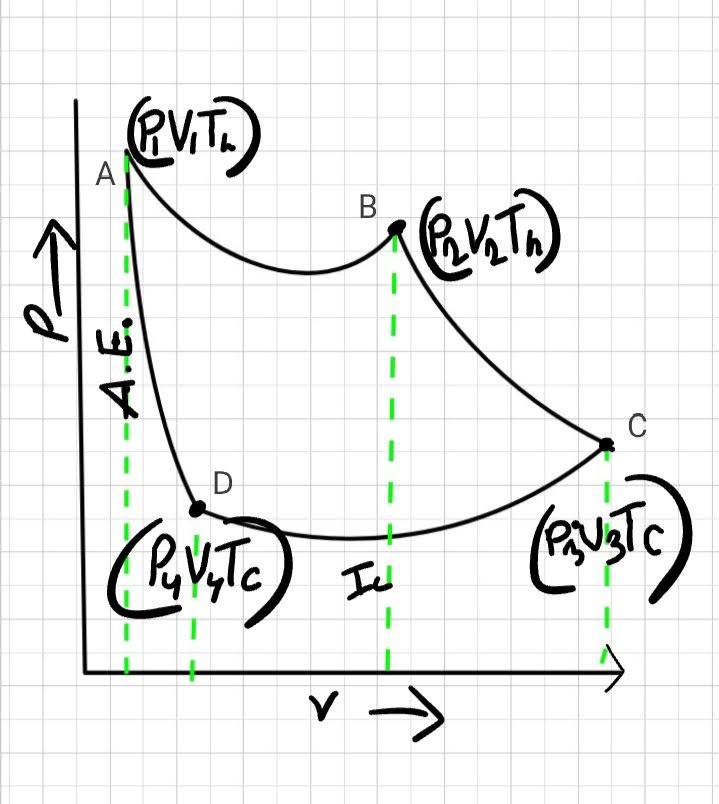
Working of carnot cycle


It contain source in temperature(Th) , sink(Tc) , insulator and a container.
It takes heat from source and throw in sink.
walls and Pistons are perfectly non conducting whereas  bottom is perfectly conducting .source and sink are at infinite heat capacity

Working  graph.


Work done in isothermal expansion
\[W_{1}=nR T_{h} ln \frac{v_{2}}{v_{1}} \\\ W_{3}=nR T_{h} ln \frac{v_{4}}{v_{3}}\rightarrow (1)...\]
Also work done in adiabatic process
\[W_{2}= \frac{1}{y-1}nR(T_{h}- T_c) \\\ W_{4}= \frac{1}{y-1}nR(T_{c}- t_{h})\]

Work done in adiabatic process is zero
\[W_{2}+ W_1=0\]
In thermodynamics expansion (b – c)
\[T_h V^{y-1}_2=T_c V^{y-1}_3 \rightarrow (2)...\]
In adiabatic compression (d – a)
\[T_c V^{y-1}_4 =T_h V^{y-1}_1 \rightarrow (3)...\]
Divide both equations 
\[ \frac{T_h V^{y-1}_2= T_c V^{y-1}_3}{T_h V^{y-1}_1=T_c V^{y-1}_4} \\\ ( \frac{ V_2}{V_1}) ^{y-1}=( \frac{ V_3}{V_4}) ^{y-1} \\\  \frac{ V_2 }{V_1}= \frac{ V_3}{V_4}  \]

Put the values of V4 and V3 in equation ( 1)
\[ W_3 = nR T_c ln( \frac{V_1}{V_2})^- \]
Total work done
\[W_1 +W_3\]

\[= nR T_h ln( \frac{V_2}{V_1})+nR T_c ln(\frac{V_1}{V_2})^- \]
\[= nR T_h ln( \frac{V_2}{V_1})(-nR T_c ln(\frac{V_2}{V_1})) \]
\[   = nR (T_h -T_c) ln( \frac{V_2}{V_1})\]
Efficiency
\[= \frac{W}{Q_1} = \eta =\frac{W}{W_1}\]
\[ \eta = \frac {nR (T_h -T_c) ln( \frac{V_2}{V_1}) }{nR (T_h ) ln( \frac{V_2}{V_1}) }\] 


\[ \eta = 1- \frac{T_c}{T_h}\]


click here  to see T-S diagrams of thermodynamic processes